Tuesday, 31 July 2012

Artist Uncovered: Damian Callan


For my second blog, it is my pleasure to ‘uncover’ the artist Damian Callan.

The human body in motion is a constant source of inspiration for Callan. He often depicts his own children, in groups or singly, by the sea or swimming pools as they paddle, row, run and sometimes simply stand still or sit down. But even when apparently motionless, the body is not inert and Callan’s consummate knowledge of anatomy illustrates this paradox with mastery. His paintings and drawings convey all the fun and happiness that children find in physical pursuits. They exude health and well-being.

The two paintings in the Art in Healthcare collection are early works from Callan’s degree show at Edinburgh College of Art in the mid 90s and both are set in swimming pools.  They are quiet studies. In ‘Boy with Armbands’, there is no splashing about, no shrieking with fear or pleasure, rather the artist has chosen to describe the motion of the bodies as they wade slowly through the water, feeling its weight as they push their way through.  As in most of his work, the figures are rendered broadly and details are kept to a minimum. This simplification is deliberate as it emphasises the subject’s movement and the dynamics of the composition.  


                         'Boy with Armbands' Damian Callan, oil on board, 1995, Art in Healthcare collection

Another of Callan’s skills is his use of back-light and shadows to create an atmosphere. It comes as no surprise to read on his website that he admires Edgar Degas, the Impressionist grand master of light and movement, famous for his studies of ballet dancers and horses and for his dramatic use of ‘contre-jour’. In both paintings in the Art in Healthcare collection, Callan has captured to great effect the particular luminosity, a mix of artificial and natural light that saturates swimming pools.

Following a commission by Sports Scotland to produce a series of paintings for their head office in Stirling, Damian Callan has been, for the last four years, in tune with the nation’s Olympic mood and working with divers from Edinburgh and young gymnasts from Lasswade. With oil and charcoal and also, for the first time, with stencils, he has pushed the process of abstraction further still. 

                                         
                                   'Handstand' Damian Callan, oil on canvas, 2012, the artist's collection

He has clearly enjoyed the experience: “It has been a treat to work with all the movement in these disciplines as well as the colour in the swimming pools”. But he also confides that he has missed not working with his children. Even without that personal element, I feel assured that he will have grasped the essence of his subjects and as one of his ex-pupils, I know that he will have made them feel relaxed very quickly and helped bring out the best in them.

Martine F Pugh is a freelance writer and visual artist based in Edinburgh.


Wednesday, 25 July 2012

Volunteering with Art in Healthcare

My name is Martine, I started volunteering for Art in Healthcare (AiH) in January this year and have been involved in five different projects since. This first blog allows me to look back and reflect on my experiences over the past six months.
AiH has a large collection of high quality contemporary artworks which they place in hospitals and care homes all around Scotland. My first job was to promote this service to care homes and explain how it can improve their patients’ quality of life. It was a revelation to me. I learned as much about these homes and patients’ care as they did about AiH’s services. The length of calls varied between a few seconds to 20 minutes and I am grateful to that manager who took the time to educate me in the needs of her patients.
'April 1997', Barbara Balmer, currently at the new Royal Victoria Hospital
Next I helped with the documentation of AiH paintings for the Public Catalogue Foundation, a national project which will eventually make available online every oil and acrylic painting in the public domain. Led by the collection manager, the AiH team of volunteers went to track down all such relevant paintings hired out to hospitals and homes. Eventually each artwork was taken down, photographed and rehung.  A considerable achievement made even more interesting wherever the description on ‘the list’ had become somehow disconnected over the years with the actual painting. We met some wonderful hospital staff as we searched around. Somehow, when put together, the words ‘art’ and ‘healthcare’ seem to make people want to talk and share anecdotes.
I also met up with another volunteer and shadowed her as she gave a talk in a care home about two paintings hired from AiH. I was able to see for myself the positive impact this carefully planned activity can have. At the end of the talk, some of the residents who had appeared disengaged at the beginning were chatting with her about the paintings and reminiscing about their own experiences.
'Energy is Delight', Alan Davie, currently at the new Royal Victoria Hospital
Next I became involved with the QR (Quick Response) code project. AiH are gradually encoding each of their work on display in hospitals and I was part of a team tasked with writing up reviews for the paintings going to the new Royal Victoria Building in Edinburgh’s Western General Hospital. I found this opportunity very enjoyable and it allowed me to put into practice my training in art history. My list of artists included some prominent Scottish painters such as Barbara Balmer, Elizabeth Blackadder and Alan Davie. It was a pleasure to research the artists and to correspond with some of them. It was also enlightening to consider their works from a healthcare perspective and the effect they can have in a nursing environment.
Finally I was asked to write the introduction to the NHS Lothian art collection for the Public Catalogue Foundation mentioned earlier. AiH were recently appointed to develop and implement their arts strategy. As part of my research I visited the Chaplain of the Royal Infirmary who has an encyclopaedic knowledge of the collection. He gave me some fascinating insights into its history and the logistics of displaying works in hospitals, an exercise which can provoke strong reactions, positive and negative, from staff and patients.
When I started to volunteer for AiH I never imagined the range of activities they are involved with or the variety of tasks that would be opened to me. It has been, and still is, an education.

Wednesday, 11 July 2012

Why do trustee boards matter?

Art in Healthcare are pleased to have our first guest blogger this week!
Gavin McEwan is a well-established charity lawyer and dedicated member of Art in Healthcare's board. Gavin writes about the importance of a strong, involved board for a charity.

One of the things we take seriously at Art in Healthcare is the people who make up our board of trustees. Indeed, the composition of trustee boards is a hot topic for charities across Scotland and beyond, keen to build on the principles of good governance. So why do trustee boards matter so much?

It may be helpful to take a step back and to understand what trustee boards are for. In most charities, other than the very smallest, day to day work is frequently carried out by paid employees or volunteers or a combination of both. Trustees are often not involved in that day to day work in a hands-on way. But it would be a mistake to assume that the trustees have no role to play.

Charity law provides that the trustees are responsible for the control and management of the charity’s affairs – so if something goes wrong, the buck generally stops with the trustees. In some cases, the trustees can be personally liable for mistakes made, and have to pay out of their own personal pockets in order to make good any costs or losses. Trustees therefore have real responsibility for overseeing the strategic development and operation of a charity and they carry a number of important legal duties.

freedigitalphotos.net

Given the responsibility which trustees bear, it is critical that a trustee board has the right mix of skills and expertise to ensure that their charity is managed to best effect. Getting the board structure right can be a tricky process and needs care and attention. In my “day job” as a charity lawyer, I meet clients every week who are concerned about their governance structures and whether their trustees fully understand their legal duties and the responsibilities and risks which they carry. A large part of my job is to advise charities which board structure is best for them, and to train boards of trustees to help them get it right.

Can things really go wrong if the board doesn’t contain the right people? The answer, unfortunately, is yes. A number of charities have made the newspapers in Scotland over the years because there was some problem with their board structure, or because the trustees had not performed their duties properly. That not only creates negative publicity and the risk of investigation and penalties from charity regulators: it can also expose trustees and charities to financial loss, endangering vital project work, and affecting relationships with funders and other stakeholders, sometimes irreparably.


At Art in Healthcare, we take some care in selecting the trustees who serve on our board. We look at gaps in our skills base and we identify people who can help to fill the gaps. In the end, what we are constantly working towards is a board of trustees with a wide range of knowledge and experience to help Art in Healthcare move forward successfully, tackling any problems that arise on the way. You could say that we are creating a collage of complementary trustees: perhaps that’s not a bad analogy for an art charity!


Gavin McEwan is a charity law partner at Turcan Connell and is the Vice-Chair of Art in Healthcare. He is accredited by the Law Society of Scotland as a Specialist in Charity Law.

Wednesday, 27 June 2012

Artist's Uncovered: Olivia Irvine

Our ‘Artist Uncovered’ for June is Scottish painter and artist Olivia Irvine. Irvine’s work is a fascinating inclusion in the Art in Healthcare’s collection. One part is due to her art, which I’ll discuss in a moment; the other is that her professional and artistic career combines art with healthcare. Initially she pursued a career in medicine, studying and volunteering as an auxiliary nurse during the summer months; however after realising where her true passion lied she switched to study drawing and painting at the Edinburgh School of Art. The experiences she had while working and studying in medicine gave her a real interest in issues involving art and healthcare institutions.

Irvine paints a whole manner of different situations and draws from inspiraion from across the world. The three paintings in Art in Healthcare's collection are all inspired by gardens. Each one is an image of the outside world which contains its own unique metaphor. For example ‘Kite flying’ is a symbol of freedom. The monoprint depicts the idyllic scene of two children flying a kite in a lush green field. It is an uplifting and bright image that allows for nostalgic response as it reflects an enjoyable children’s pastime.


Kite Flying
Olivia Irvine

‘How does your garden grow’  is a rather intriguing image, an insight into the artist’s memory as she paints a scene from her early childhood. The landscape here is one she used to spend time in as a little girl and the painting explores how the centre piece of that landscape changed from a sandpit to a flower bed. The painting is abstract and multilayered with different tones and shades, playing on light vs. dark. The feelings she explores with this image are this idea that landscape can grow and change simultaneously to us growing up and changing as people.

 ‘I want to invoke a psychological response’

How Does Your Garden Grow
Olivia Irvine

‘Another metophoric painting of Irvine's we have in Art in Healthcare's collection is 'The heat of the moment’ . This simple painting of a young tree surrounding by a metal protector acts as an artistic metaphor for protecting oneself against adversity. This is my personal favourite image out of the three as I feel it perfectly sums up Irvine’s artistic inspiration and practise. She takes a simple and familiar landscape and creates a pictorial language that conveys a comforting and positive dialogue. I believe this is one of the many reasons her work is so suited to Art in Healthcare.
The Heat of the Moment
Olivia Irvine

Olivia Irvine’s paintings are colourful and interesting additions to healthcare settings. They invoke an optimistic and affirmative message that is so important when being exhibited in spaces that may traditionally hold negative connotations. Irvine's relatable and familiar pictures are a very welcomed addition to both the Art in Healthcare collection and the healthcare settings they are displayed in.
 
‘It is great for patients, visitors and staff. It makes the place looked cared for.’

Tuesday, 12 June 2012

Hard Rock Cafe: Dining with Art in Healthcare

In recognition of the National Volunteer’s Week from
1st - 7th June, Art in Healthcare were treated to a special evening hosted by the Hard Rock Café in Edinburgh. The HRC provided a fantastic complimentary dinner for some of Art in Healthcare’s dedicated volunteers and thanks to the outgoing and friendly restaurant staff, the evening was a great success.  
Art in Healthcare's team of volunteers


Not only was it an amazing gesture of thanks to all of the hard graft the volunteers have put in over the last couple of months, but it was also an opportunity for Art in Healthcare’s volunteers to meet one another and see the diverse and interesting community who contribute to the charity and its work.


At Art in Healthcare we rely on our volunteers to help out with a number of projects, from restoring paintings, to hanging pictures, and carrying out fundraising talks. If you’d like to get involved in our volunteer programme and think you have something to offer Art in Healthcare then please get in contact with our Outreach Manager, Amelia on outreachmanager@artinhealthcare.org.uk.

We would like to thank the team at Hard Rock Café for their generosity and a fantastic night and hope to do another event for our dedicated volunteers soon.

Wednesday, 30 May 2012

Callum Innes: Works on Paper Fundraising Event


On 8th May 2012 Art in Healthcare hosted a hugely successful fundraising evening at the Ingleby Gallery with the  internationally recognised Scottish artist, Callum Innes, giving a tour around the gallery and his paintings currently on show. Innes studied at Grays School of Art in Aberdeen before going on to establish his own style of reductive painting. He was nominated for the Turner Prize in 1995 and later went on to win The Jerwood Painting Prize in 2002.


Walking into the Ingleby Gallery I had no idea what to expect from Callum Innes’ latest exhibition. As a relative ‘newbie’ to contemporary art myself I was looking forward to hearing about the thoughts and processes which go behind his modern, minimalist style.


Innes’ work is often very bold and intense, making use of statement colours and shapes to draw emotion out of the audience - a complete contrast with the artist himself who was very soft spoken and eloquent as he addressed the 20 or so people gathered in the gallery with a great passion for his work and craft. Everyone attending the evening’s fundraising event was pinned on his every word as Innes described his beginnings as an artist, his old college tutors, anecdotes of artists he had worked with, and parts of his life which had inspired his own art. 


“All these works are fragile, emotionally, physically…and (they) retain a human fragility about them. They’re imperfect; if they were perfect they wouldn’t work”


Untitled No 33, 2011
Oil on Canvas


He told us how he regularly finds himself throwing work away and how he is somewhat of a perfectionist. Once out of the studio or exhibition context he regularly sees his work in a completely different light and often discards it completely. He once worked with curator Marco Livingston on a run of 50 books which were to be beautifully letter pressed and each covered with an individual painting. However, when the time came to wrap the books, it was discovered the paintings had been cut down 2cm too short and were therefore unusable. Innes immediately went up to his studio, gathered pictures which had been displayed in the Tate and in the ICA, and cut them all down to the correct size, destroying 30 paintings to make 50 books.


“It was about trying to achieve perfection. I learnt in that process of looking at your work and making decisions about it. I learnt how to edit, which is something you can only really learn through time, and I’m still learning.”


The ‘Works on Paper’ exhibition at the Ingleby Gallery fundraising event was filled with paintings focussing on what had been taken away from the painting, what wasn’t on the page, and what had been left behind, rather than what had been created by the paint. Innes described how when painting onto wax paper, turpentine made certain parts disappear and it was this in which he was most interested


Untitled, 2008
Oil on wax paper


Having been a figurative painter until his early 20’s Innes told us how he slowly worked the figure out of the painting but still kept the gesture and the marks to make paintings as objects. The small series of squares which were displayed on the upper level are an example of this. Two blocks of colour had been painted over each other  freehand to create a semi-transparent look. The result is wonderfully effective and the bold colours oozing out the side of squares really draw in the eyes of viewers.


Quinacridone Violet / Lemon Yellow, 2012
watercolour on paper


“In all the paintings I make there is always a single line that goes through the painting; there’s a moment where the canvas is filled with oil paint and I take a line from the bottom to the top of the canvas so it doesn’t meander, it looks like its formed naturally but it’s controlled, picked out very delicately and it forms itself at a certain point.”


 Innes’ work will be displayed in the Ingleby Gallery until 14th July 2012 and I highly recommend you make a trip along. Seeing the different layers and textures of the paint on the paper, and understanding the form and gesture of each painting gave me a much greater admiration for contemporary and abstract artists. Innes has also kindly donated two pieces of his work to Art in Healthcare’s collection, one of which will be displayed in the new Royal Victoria Building at the Western General Hospital along with a large selection of other fantastic artworks from our collection which we have just recently hung there.

Wednesday, 9 May 2012

‘ARTISTS UNCOVERED’: Heather Pugh

My name is Melissa and I am a post graduate student at the University of Edinburgh with my academic interests focusing on art, design, history and culture. I became involved with Art in Healthcare as I’m passionate about getting art out of the gallery and into the community. This is the first blog post for an exciting new project entitled ‘Artist’s Uncovered,’ where Abi Allsopp (AiH's new Media Manager) and I will highlight an artist and their work belonging to the Art in Healthcare collection. The project aims to increase awareness of the various and exciting artworks on display in health and care settings through a bi-monthly blog paired with a video showcasing the chosen artist for that month. Furthermore it enables me to explore why artists are attracted to the charity and how they feel about exhibiting their creations outside a more traditional gallery setting.  

Off the Cuff
 
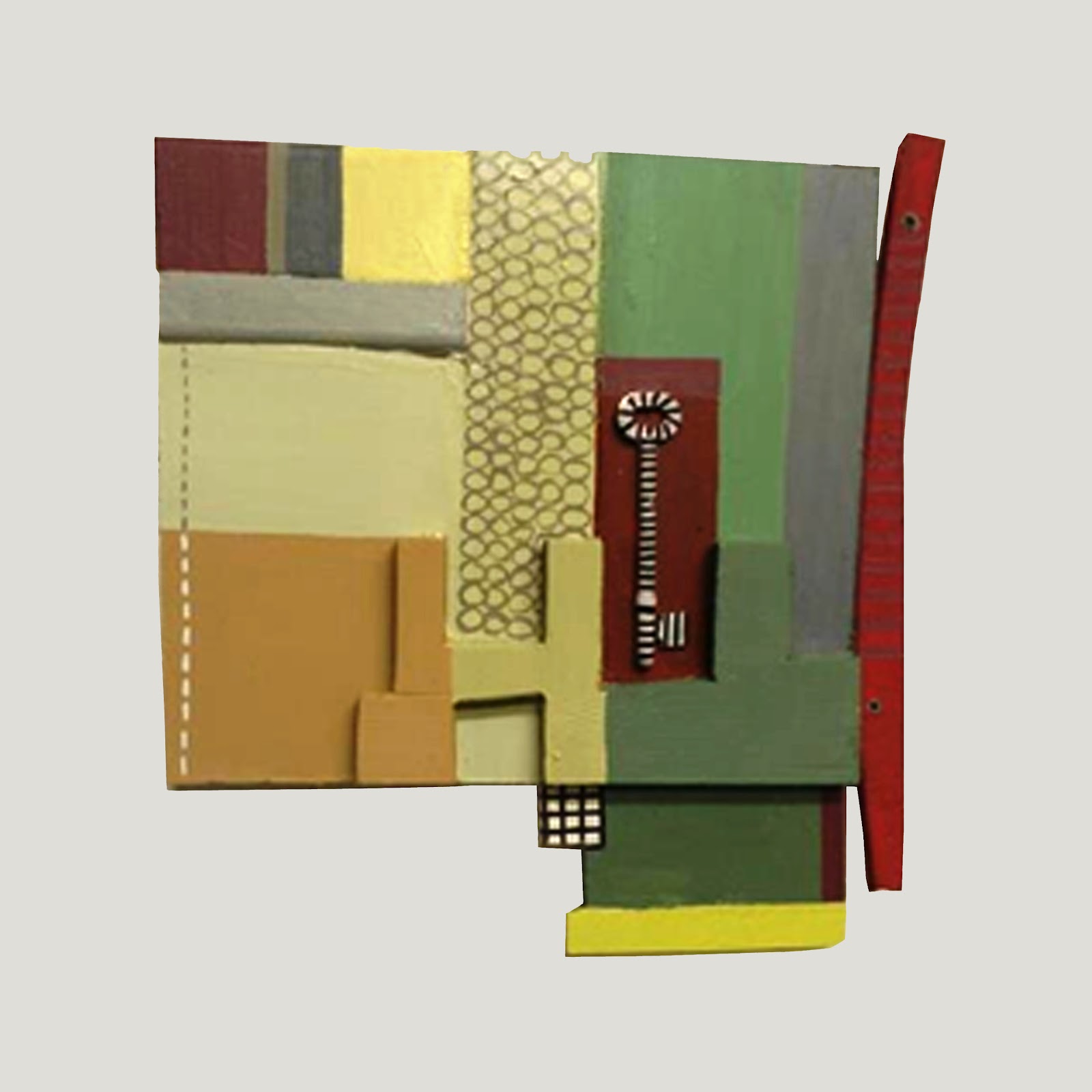
Heather Pugh’s sculptural artworks are fantastic additions to the charity’s art collection and are already earmarked to be put on display in Edinburgh’s new Royal Victoria hospital with generous financial support from the Hope Scott Trust. Her paintings are bright, colourful and quirky, illuminating warmth and cheerfulness. Each of her creations is completely original and could not be replicated as she utilises objects discarded in bins or found on the city streets. She then arranges these found objects, adding or cutting away at them before applying paint and sometimes other media to create multi-layered and intriguing artwork. Her inspiration stems from the things she finds, taking something ordinary with a defined purpose to establish something new and completely unique.
‘To be blunt my work is almost like glorified recycling’
Ten of her works have been purchased for the AiH collection to be displayed at the hospital and my favourite is ‘Off the Cuff.’ The colours make up an attractive palette: contrasting and bold yet still working together and with the multiple components making the piece visually stimulating. Firstly, there are everyday mundane objects such as a hinge and a door handle, which are painted over in geometric pattern and stripes transforming the lowly door handle into a decorative adornment. Pugh is interested in hinges because of their use and function; they are designed to open and close doors and compartments but by placing them in an alien environment their function changes completely.
Another exciting piece is ‘Sign of the Times,’ which drew my attention by incorporating a key initiating me to ponder where the item originally came from and did the owner miss it. Is whatever the key used to unlock unable to open now? The idea for the painting was inspired by Pugh playing with a piece of wood on her jigsaw, which then developed and expanded after a friend gave her some unwanted objects, including the keys.
‘A key is something every day and by changing its function it tied in with my theme of recreating the mundane.’

Sign of the Times

‘Every Nook and Cranny II’ was also motivated by Pugh’s jigsaw and relates to a piece she made the year before that shares a similar colour palette. The aspect that really interests me in this painting is how she cuts away at the artworks surface, revealing new layers and sometimes completely exposing the wall behind. The manipulation has been made through the addition of enamel and acrylic paints and removing pieces of the jigsaw puzzle and wood.
These artworks are exceptionally enjoyable to look at and emit a positive energy that patients, staff and visitors will greatly appreciate. Most people who need to spend time in a hospital would likely rather be anywhere else and as these environments can be quite dreary, clinical and even a little scary, colourful and uplifting artworks like Pugh’s can make such a difference. Hospitals hold many negative connotations, yet the aim of a charity like Art in Healthcare is to make places like these more pleasant and welcoming. Furthermore, Pugh hopes that her artworks will have a significant therapeutic and affirmative effect on patients’ wellbeing and happiness, as she describes below:
‘Art in Healthcare is a great way to add colour and atmosphere into hospitals, providing a type of therapy for people going through often and anxious circumstances, Things visual are often memorable in our minds eye, and I think it’s great to have art work in hospitals, which are often associated with negative times. If my work can portray any positive emotion in people, and make people smile for a moment, it’s a job well done.’

Every Nook and Cranny II


Feel free to leave a comment and tell us what you think of Heather’s work or what we're doing here at Art in Healthcare. Cheers!